
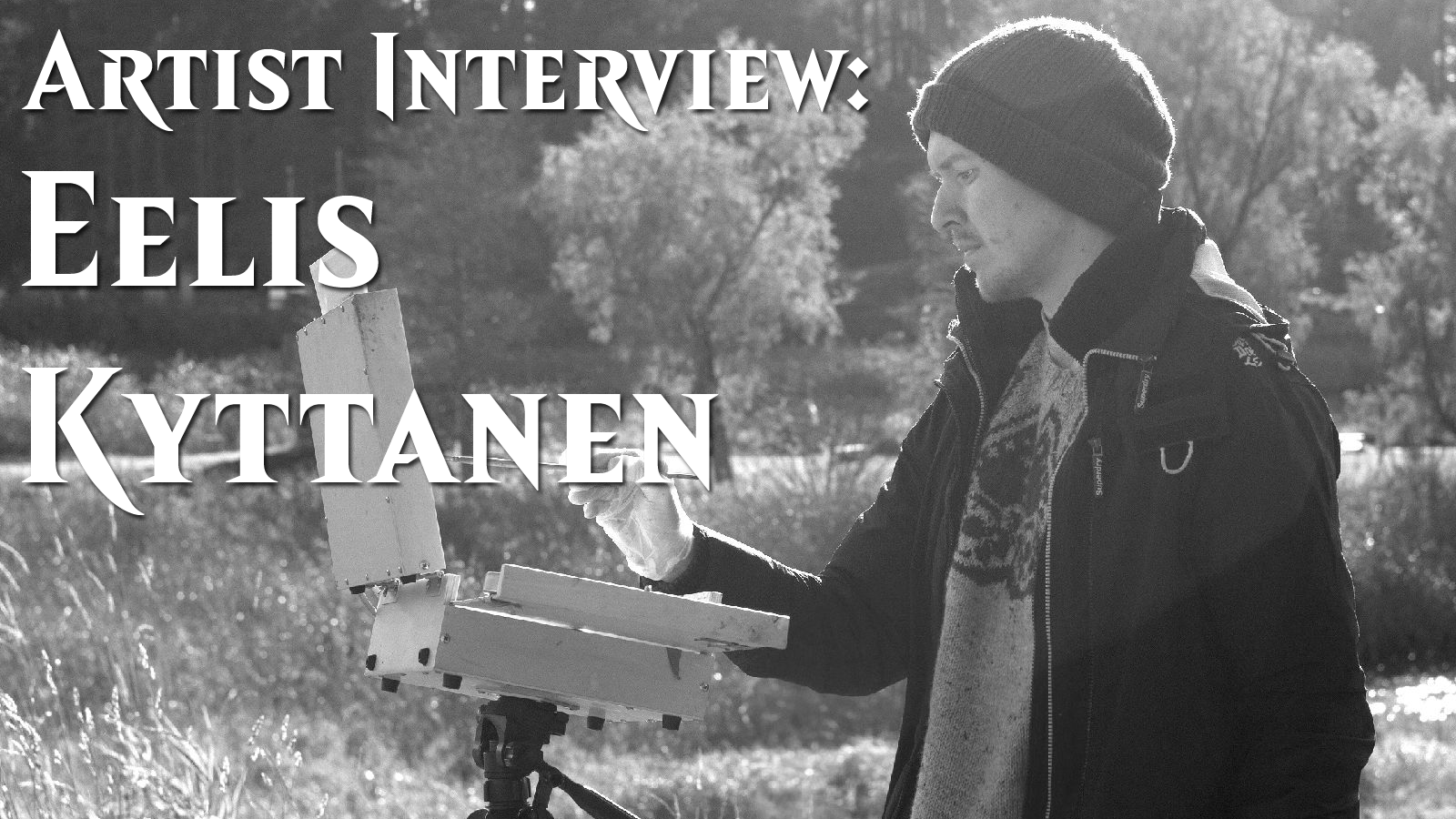
Magic Untapped interviews Magic: The Gathering artist Eelis Kyttanen.
For around a decade, Finnish-born artist Eelis Kyttanen has illustrated dozens of cards for Magic: the Gathering. While he has also been a designer and background artist on many projects, including the Netflix series 'The Dragon Prince', much of his recent work has been for Wizards of the Coast. We spoke with Eelis while he was at home in Vancouver, BC, and he had this to say...
Magic Untapped: What inspirations and influences in your life drove you to becoming a professional artist?
Eelis Kyttanen: My parents have always been quite culturally-minded so they took us to all sorts of art galleries, museums and shows from an early age. I think because of this I’ve always had an interest in the arts and knew I wanted to be creative of some kind. I didn’t actually engage with drawing/painting specifically until I was 16. I had previously mostly been experimenting with film etc., but once I realized how much you can communicate with a single image I became determined to pursue it as a skill and as a creative outlet.
MU: When working on more human-based art pieces, what do you draw inspiration from them?
EK: Mostly from academic painters of the 1800s as well as realist impressionists of the late 1800s/early 1900s. Academics such as Bouguereau and Solomon J. Solomon had an amazing eye for graceful, intentional posing while realist impressionists such as Sargent and Zorn were able to depict their subjects in a naturalistic fashion while retaining a painterly quality to their works. I think this combined with my own studies from life is the soup my figurative work is made of.
MU: Do you use Finland and Canada as influences for the outdoors parts of cards or for backgrounds?
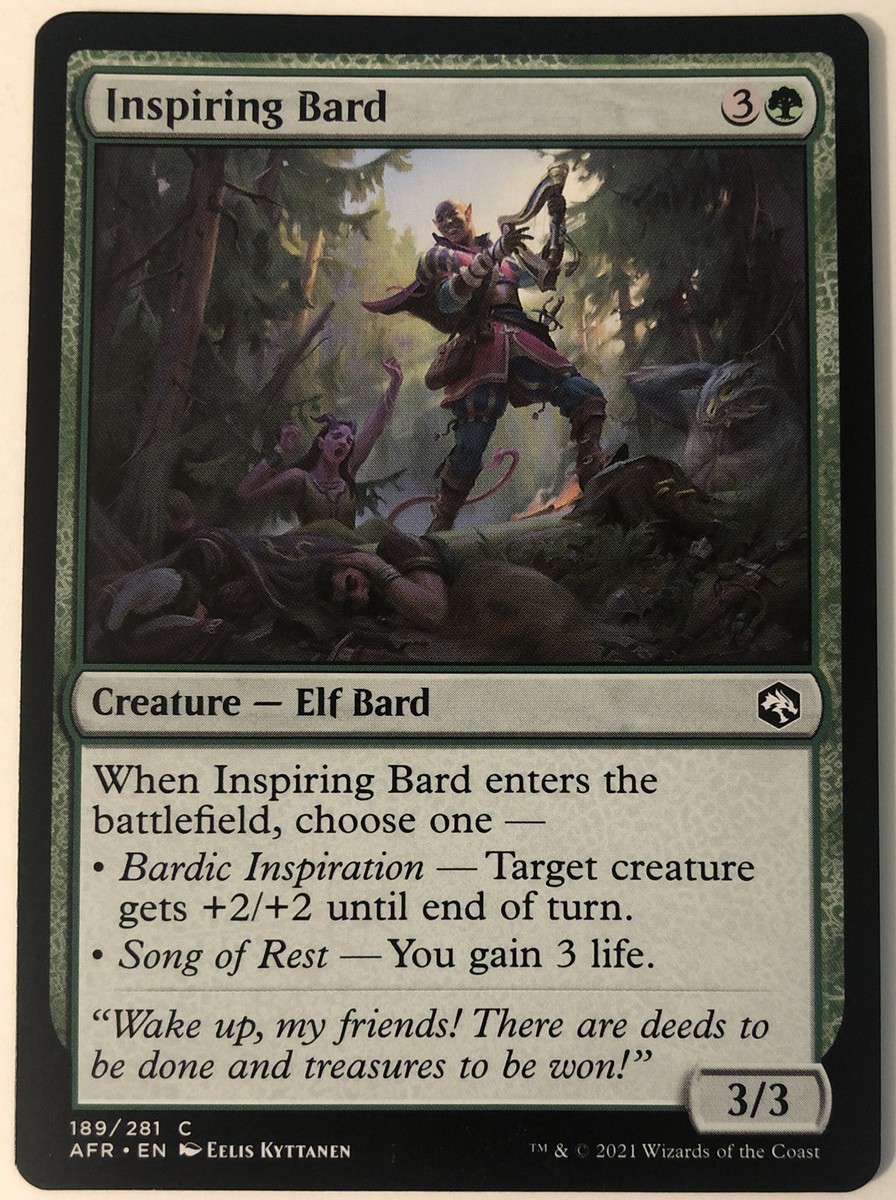
EK: Most of the time on MTG we don’t have too much leeway to experiment with the overall look of the scene as there is a very comprehensive design bible provided for each set. However, my first card, Inspiring Bard, was set in a non-descript woods somewhere in the Forgotten Realms, so I took it as a chance to depict a forest that looks quite Finnish/Nordic!
MU: How long do you typically spend on a piece?
EK: It can be anything from 15 hours to 100 hours. This doesn’t necessarily vary by the complexity of the subject matter, but rather by how smooth the early exploration and sketching process is. Sometimes even a single character scene can be surprisingly tricky to nail down and I end up spending quite a bit of time in the first stages.
MU: You’ve done the artwork on many Magic cards dating back many years. Which of your cards have been your favorites and what is it about them that makes them stand out?
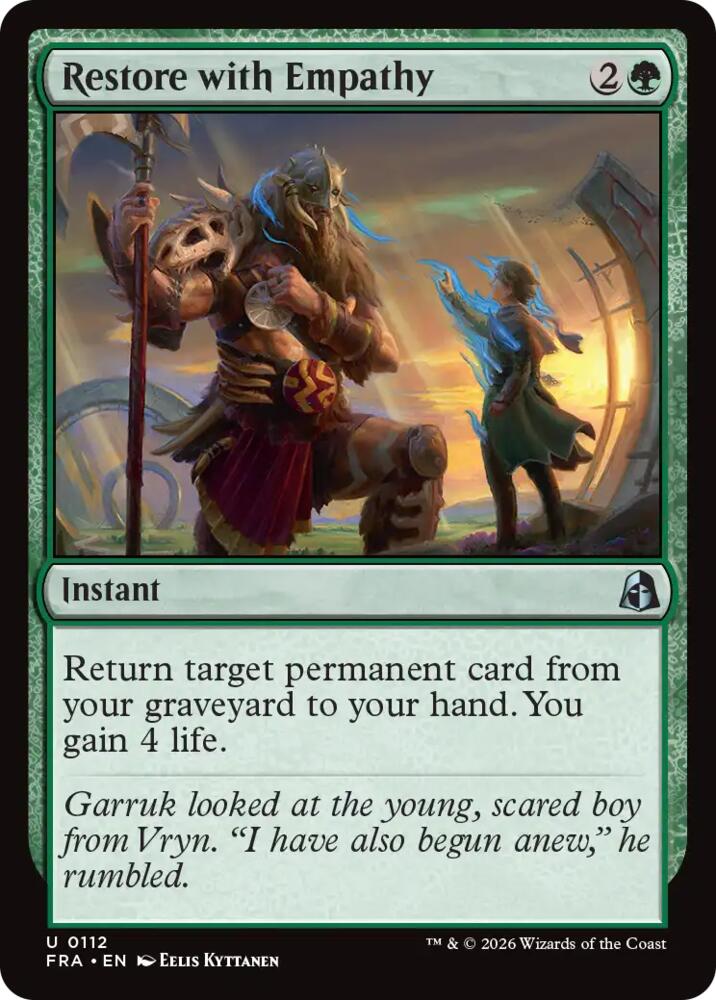
EK: From MTG lore point of view, I was really honoured to be commissioned by Art Director Zack Stella to paint Restore with Empathy. It is such a touching moment between Garruk (who is my favourite planeswalker) and the young teenage version of Jace. The prompt was beautiful (big shoutout to all the great people at WoTC who write the art prompts!) and gave me a lot of good ideas on how to handle Garruk relating to and empathizing with Jace in a way that was accurate to his character.
As for my favourite card for gameplay reasons, it must be Cryogen Relic.
MU: Do you have a favorite art piece that was in a card? And , if so, why that one?
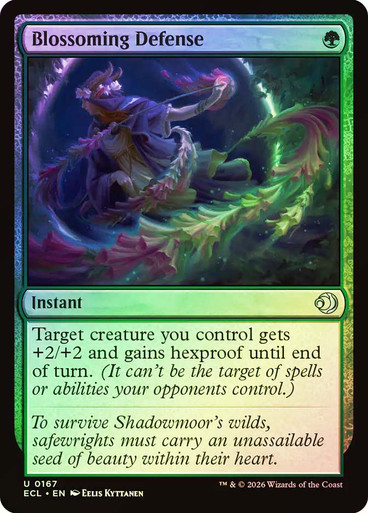
EK: There are a few! I still really like that first card I mentioned, Inspiring Bard. Everything just kind of locked into place with it. Otherwise, I really love Songbirds’ Blessing. It was my first oil painting ever for MTG and I feel like the composition of it is still one of my better paintings. But my absolute favourite is Blossoming Defense. I love painting flowers and characters striking graceful poses, so this one stands out in that regard.
MU: Have you ever tried a more "out of the box" approach to a card where you try a new perspective or style?
EK: I mostly stick to my usual style on MTG because I don’t want to surprise my art directors with something very different from my usual fare, but I’ve often experimented with slightly flatter compositions as can be seen with Songbirds’ Blessing and Blossoming Defense.
MU: As a professional artist for several decades, how has your art style evolved over the years?
EK: I’ve now been in the industry for almost a decade and for six years on Magic. Looking back, I feel like my stylistic evolution so far has mostly been a straight line of general improvement without too many side quests. But we’ll see what the future holds! The largest difference is that I mostly paint with traditional mediums nowadays, but this hasn’t really affected the look of my art that much.
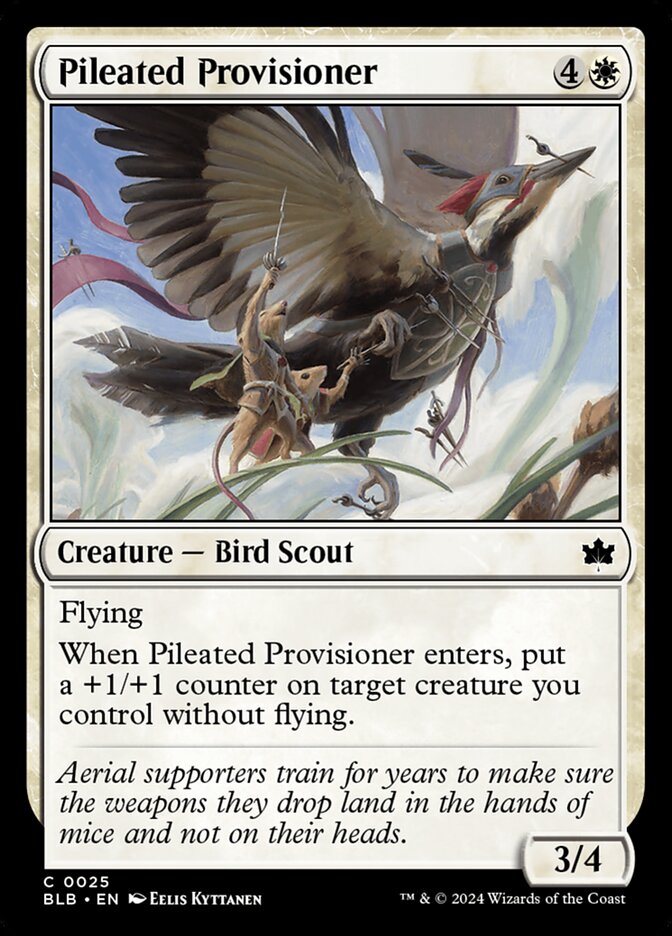
MU: You have illustrated many animal-based cards, from Pileated Provisioner to Rampart Architect. Do these ever have any additional challenges over human cards?
EK: Yes for sure. References are harder to shoot. With humanoid cards you can always use yourself or grab someone else, but with animals I often end up scouring different sources for references for quite a while. Recently, I’ve been looking at creating clay maquettes to aid with cards like these.
MU: Do you have a favorite art medium? If so, does it make fantasy artwork harder or easier to create?
EK: Definitely oil paints. They have their pros and cons. Pros include tactileness, painterliness and the fact you get a real painting out of it. However, there is no undo (I still reach out for the imaginary “control+z” sometimes out of habit) and you can’t just endlessly move things around. Rather, the whole design should be locked down from the get go. When I work digitally I often let the painting evolve and change as I paint, so it has definitely been a process to adapt away from this when it comes to the traditional mediums.
MU: What kinds of things are more tricky for you to create (landscapes, people, creatures, etc.)?
EK: Funnily enough I’ve always struggled with faces a little bit. I started my career as a background artist on animation so my move towards figurative art has been more recent. That combined with the fact that all of us are great at spotting mistakes in regards to faces is where my troubles come from. But thankfully it gets easier with every new painting.
MU: Finally, aside from continuing to play and collect Magic: The Gathering cards, how else can fans of your artwork support what you do? Do you have any future projects coming out soon you are excited about?
EK: Just following me on Instagram is a huge help! I’m so thankful to the MTG community and to everyone who sends me emails, backs my Kickstarters and comes by my booth at various conventions. I often tell people that out of all the various art jobs I’ve worked, no fan community comes even close to how supportive MTG fans are of the artists and the art side of the game in general. For that I’m eternally grateful.
Thank you, Eelis, for participating in this interview.
Check out other recent interviews with artists Lars Grant-West, Christina Kraus, Ben Hill and more!