
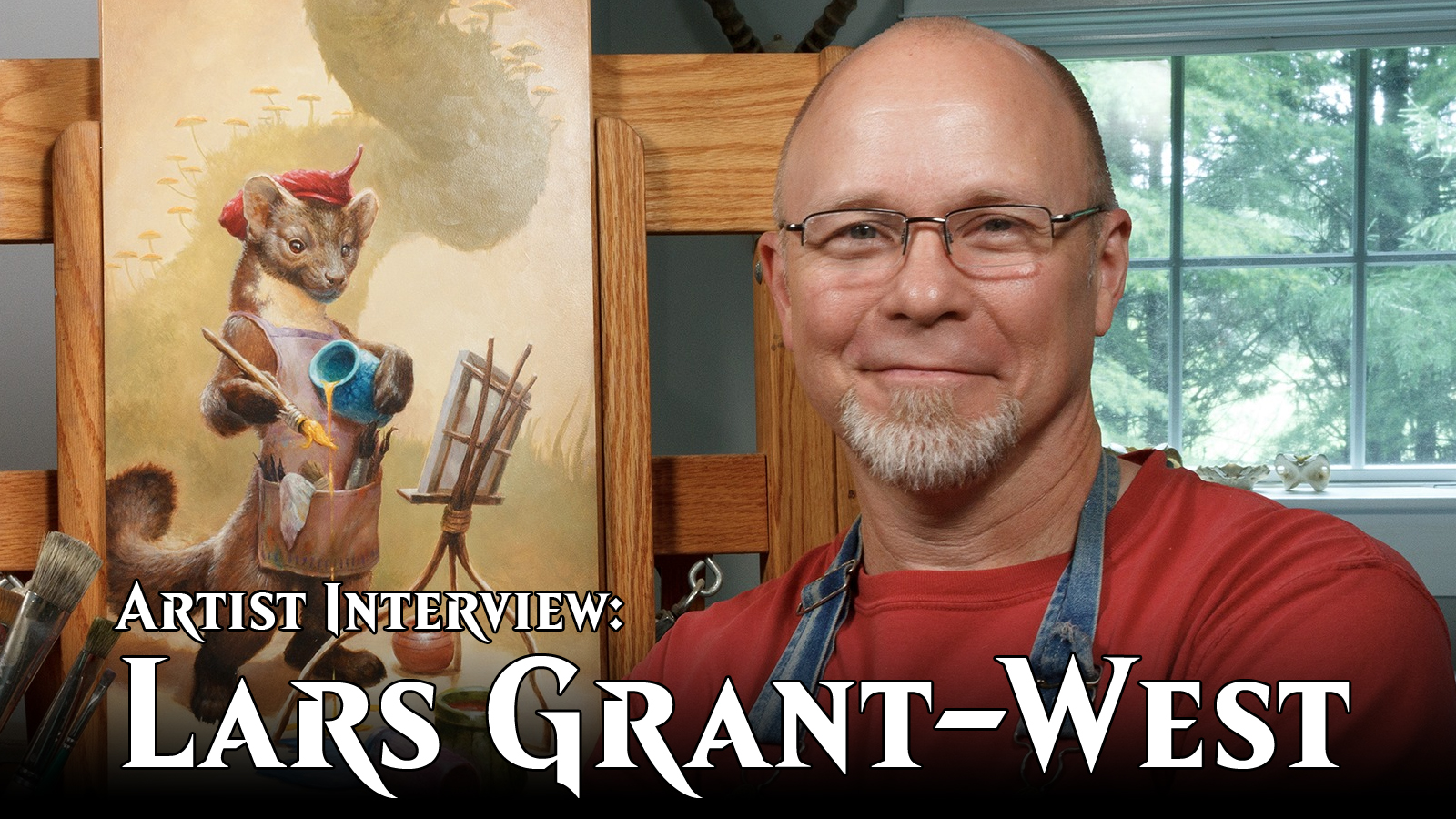
For over two decades, Lars Grant-West has been a prominent fantasy artist and illustrator.
While a major Dungeons and Dragons artist and an artist for special projects for places like the Roger Williams Zoo in Providence, Rhode Island, and for National Geographic, he has also been a major Magic: the Gathering artist.
One of Magic's natural and animal specialists, Grant-West has illustrated dozens of cards since Legions in 2003. He was kind enough to answer some questions from Magic Untapped about his career, from his start in Brooklyn amongst lots of dinosaurs, to becoming a Magic artist legend.
Magic Untapped: What inspirations and influences in your life drove you to becoming a professional artist?
Lars Grant-West: My biggest early influences were the American Museum of Natural History, the Brooklyn Aquarium, and occasionally the Metropolitan Museum of Art in New York City. My dad brought my brother and me to the AMNH fairly regularly when we were very young. Most of my core interests were seeded there. Skeletons, art, Natural History and the Natural world, evolutionary diversity, even moldmaking and casting - all were on exhibit there. I don’t know how anyone could see those massive dinosaurs and not be instantly hooked.
For me, those moments occurred a decade or two before Jurassic Park was even a book. My first exposure to T-rex was standing in front of it’s gargantuan skeleton (which at that time was also standing tall - still dragging it’s tail). The impact of seeing the remnants of these creatures in person at full scale blotted out everything else. This is an early piece of mine from that age:
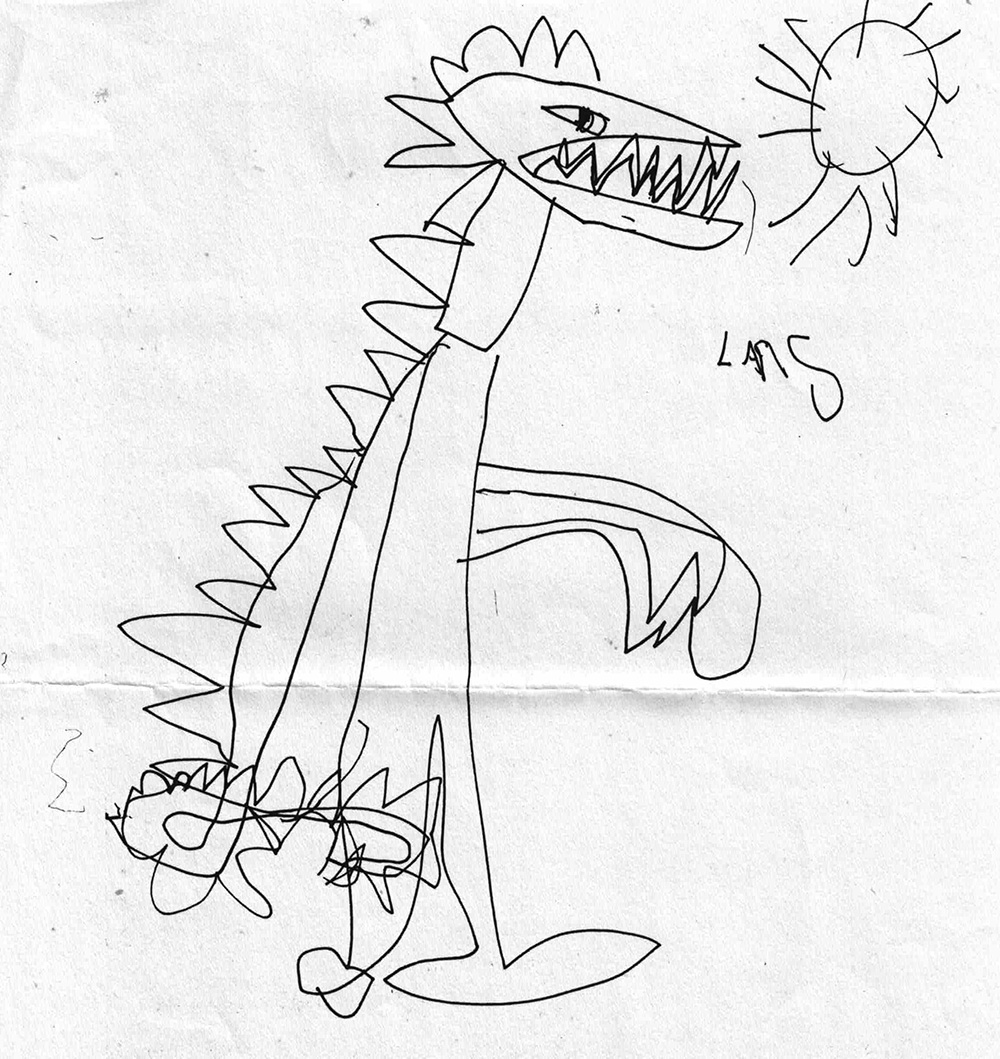
I don’t remember a time in my life when I wasn’t drawing and didn’t love dinosaurs. But I was also fascinated that this radiation of life had fanned out across all the diverse niches on the planet, constantly editing and revising itself…and that at some point in our distant past we’re related to everything, from flatworms and flies to birds, beetles, giraffes, and even that T-rex. We get hung up on the vast differences between us all, but often overlook the many ways we’re the same.
Of course, films were another form of adventure. Harryhausen movies, Creature Double Feature, Star Wars, Alien, etc. all impacted me powerfully. There was a long time when I wanted to get into practical effects work but shied away from that because I was terrified of earthquakes in a largely West-Coast oriented field. I also wanted to do scientific illustration, and have done some - but fantasy art opened up for me, and I found that there was plenty of work there.
My mom also assiduously saved and dated the drawings my brother and I did. As a result I have some insights into young me, including early dinosaurs and even dinosaur model kits I’d designed as a kid.
MU: How long do you typically spend on a piece?
LGW: It may sound strange, so I need to preface this by explaining that I was huge Mad Magazine fan as a kid. I also loved whacky packs, garbage pail kids - all that kind of satirical, irreverent fun stuff that was also very well executed. Toy Boat and Remodel were among my favorite assignments. It was fun, as an adult, to jump back into that silly space. I did more pieces digitally then because I just needed to get them done - but Toy Boat was one where I really had genuine fun. I don’t get to do that un-set stuff often. In fact that second un-set was the only one I’ve ever worked on.
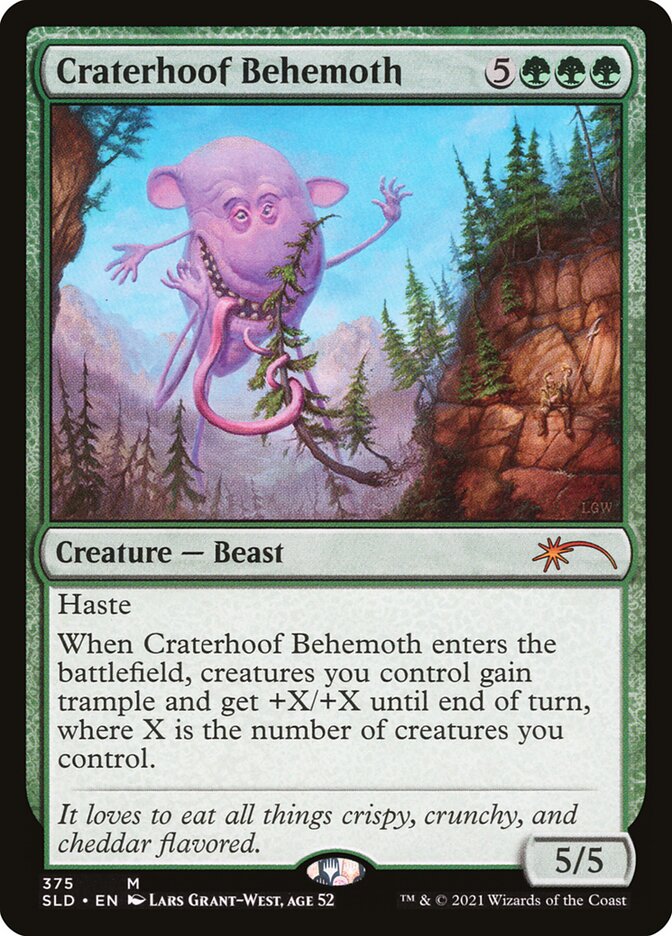
Along similar lines, the Secret Lair/Extra Life set in 2021 was an absolute blast. I got to do a painting using a young five-year-old girl's drawing as a sketch. I swear I was grinning ear to ear the whole time I was working on it. It was important to me to match all of Kira’s lines, at least on the creature, as closely as I could. I wanted to honor the energy in that sketch. Kids drawings are so fascinating before they learn about perspective or accurate scale or any of that stuff - They’re all about telling a story and they only show the important stuff.
If you look in the lower right corner of the piece, you’ll see the doomed traveler sitting on the side of the cliff in the lower right. He's whittling Chris Rahn’s version of Craterhoof Behemoth in there as a nod to Chris and his original version of the card.
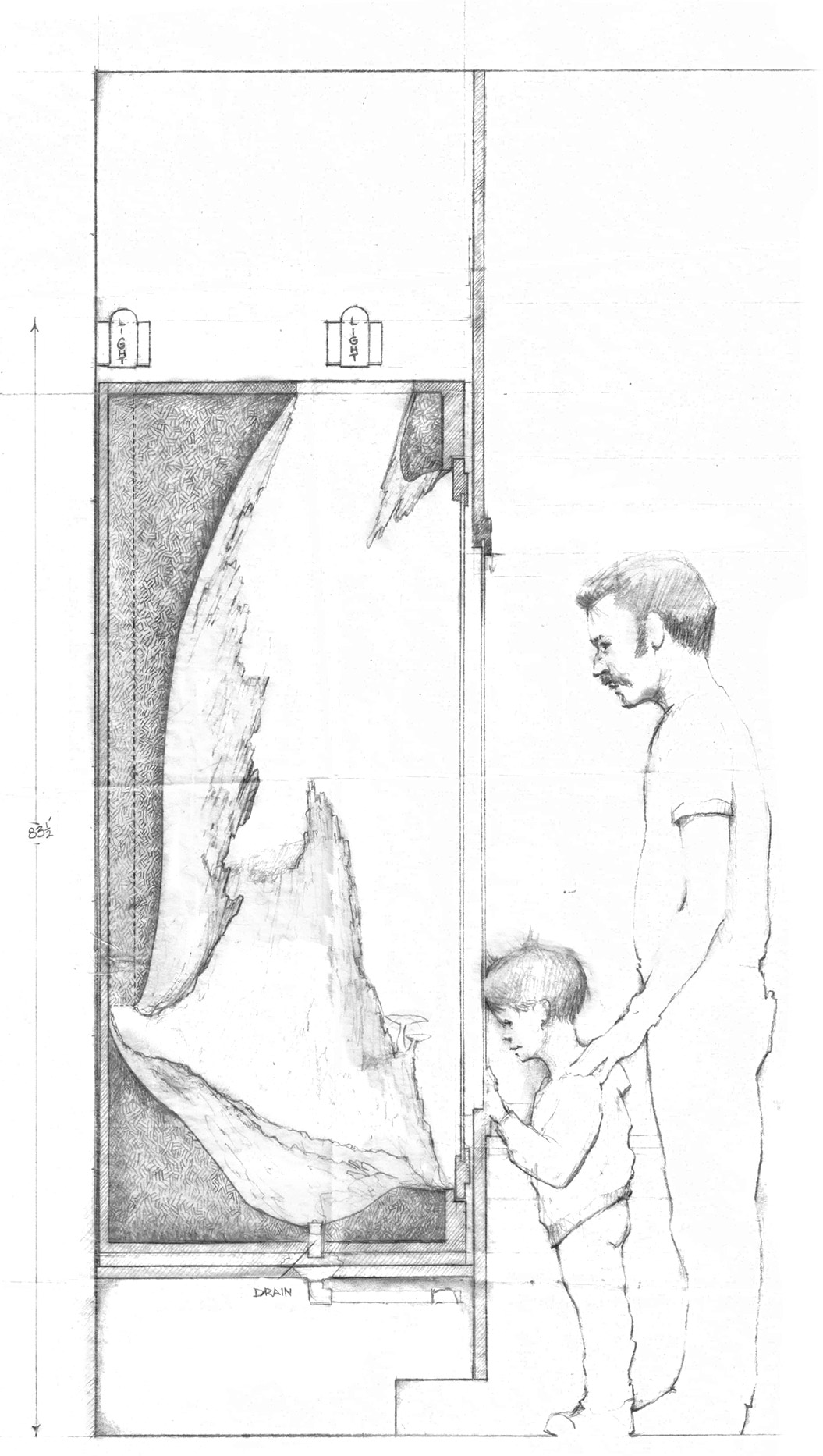
Hasbro’s Children’s Hospital is a very short distance from my house. They still have oversized prints of all those cards in the windows. I loved that the kids got their art on printed cards too. I had done some exhibit work with the zoo and saw first hand how important that facility was for the kids there for treatment…so even bringing a few moments of enjoyment guided by their drawings was deeply touching to me. This is a cutaway for a Madagascar Hissing cockroach exhibit from my exhibit design years.
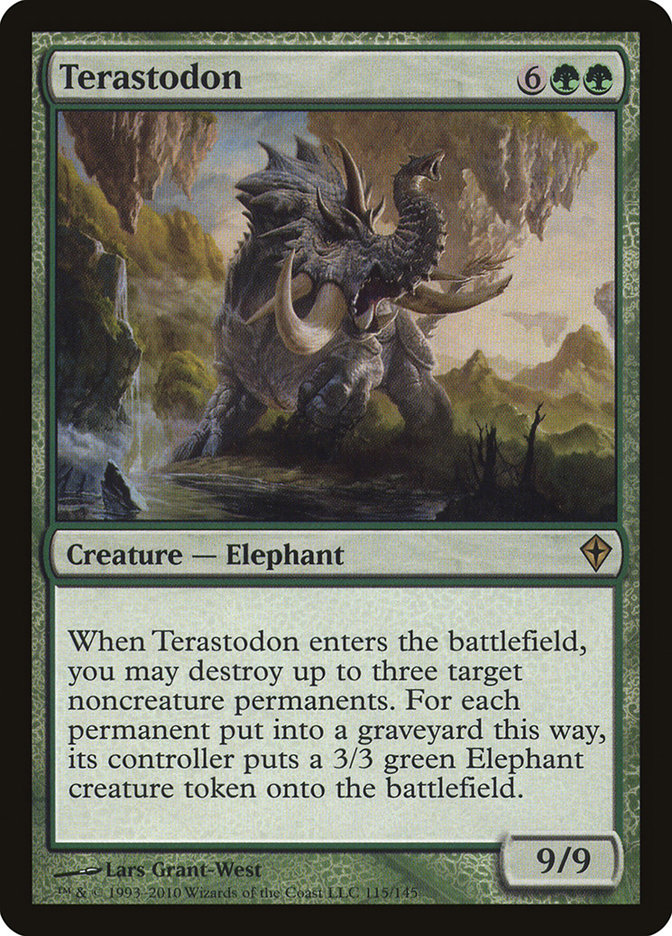
Other older cards that pop into my brain that I was happy with: Read the Bones, Gorgon Flail, and Terastadon. More recently, I’ve enjoyed Bramble Wurm, Scurrid Colony, and Territorial Aetherkite. I was also please with the paint on Vault Skirge…even though it was just an alternate art.
MU: How has your art evolved over the years?
LGW: I don’t even know how to answer that. I have so many interests that I always feel a bit too scattered to identify a hard shift at any point. I think my approach to Magic has changed in the sense that the pieces have gotten larger. Partially due to older eyes, but also more demand for detail over the years. I’ve always admired approaches that applied paint more roughly, so I’ve played with that occasionally as well with varying degrees of success.
MU: Have you ever tried a more "out of the box" approach to a card where you try a new perspective or style?
LGW: There have been a few pieces where I intentionally switched styles a bit. Marrow Chomper is an old example, but I was really going for more of an old comic book vibe in that one.
I already mentioned Toy Boat and Remodel - which shifted because of the nature of the set and due to the time constraints of working on World of Warcraft and Zoo work at the same time.
Within magic however, I primarily paint in oils - and sometimes acrylics. For some projects it’s just better. The Precursor Golem schematic is an example of where I approached a job with a style that was old for me rather than new. I got to dust off my old drafting tools and have some fun using very different techniques. It was a nice change of pace.
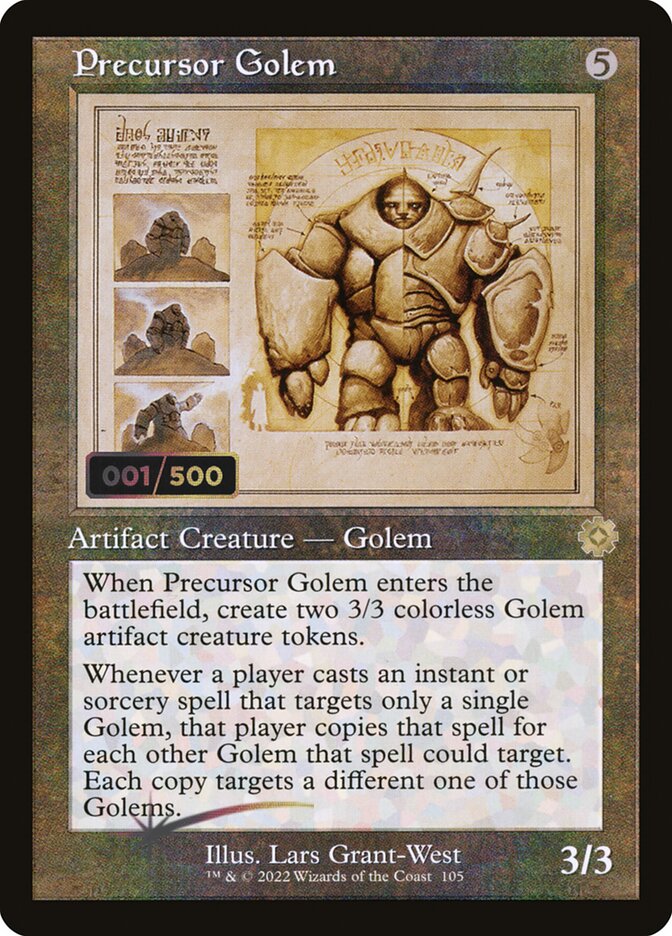
I don’t play a lot stylistically because I don’t feel it’s fair to the art director. If I switched my style too much it would be a little like I woke up one morning and started speaking with a cockney accent. No matter how well I did it, it wouldn’t feel authentic.
I enjoy a variety of approaches to reference building though. I try to use each assignment as a justification to improve on an existing skillset or acquire a new one. I have fun with 3D modeling, 3D scanning, etc., and also enjoy sculpting traditionally as well as digitally…so it’s fun when I get to play a bit. There were early cards where I experimented with a digital 3D/digital drawing hybrid process, like Extraplanar Lens, Trash for Treasure, or Glimmervoid, which I think was the first fully digitally raytraced magic card. I don’t know that for certain, but I think it’s true.
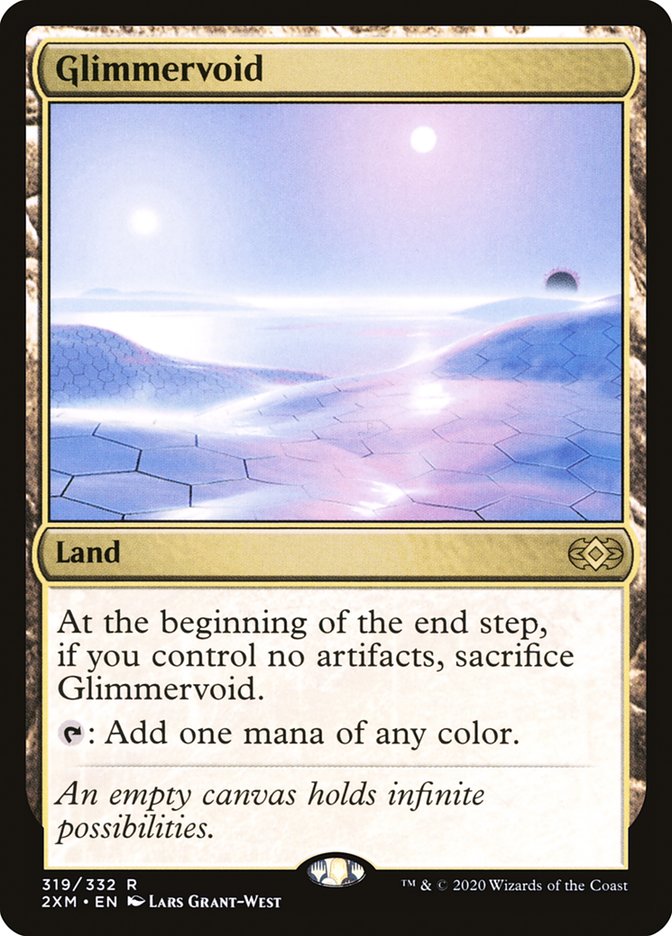
There’s the nerd side of me that would love to go back and revisit these with better software and improved skills, and the painter who’d love to go back and reimagine some of those as oil paintings, but short of getting assigned the jobs again, that isn’t practical.
One example of a card I really enjoyed building partly in 3D, but then finishing as a painting was Tormod’s Crypt. Often the digital portion ends up being a pre-visualization tool. I still have to build everything, but then I get to play with it more like a photographer waiting for the right light from the right vantage point. It’s a strange twist.
MU: You tend to gravitate towards creature cards, with more realistic designs like the artist weasel in Artist's Talent and the wolves in Howl of the Night Pack to more fantastical creatures like the Frostwalla. How do you plan for such artworks and what kind of creature do you like doing most? Do you do things like take zoo visits to help aide you in your art?
LGW: I spent about 12 years working at the zoo in Providence while I was getting my art career rolling, so there was plenty of inspiration there.
It’s true I often get assigned realistic animals. It’s not that the art directors wouldn’t give some latitude if something cool came up in a sketch. It’s that the name tends to lock a picture in for me, so that’s what I go with. If they ask for a bear, a wolf, or an elephant, that generally means something pretty close to the animals we recognize by that name.
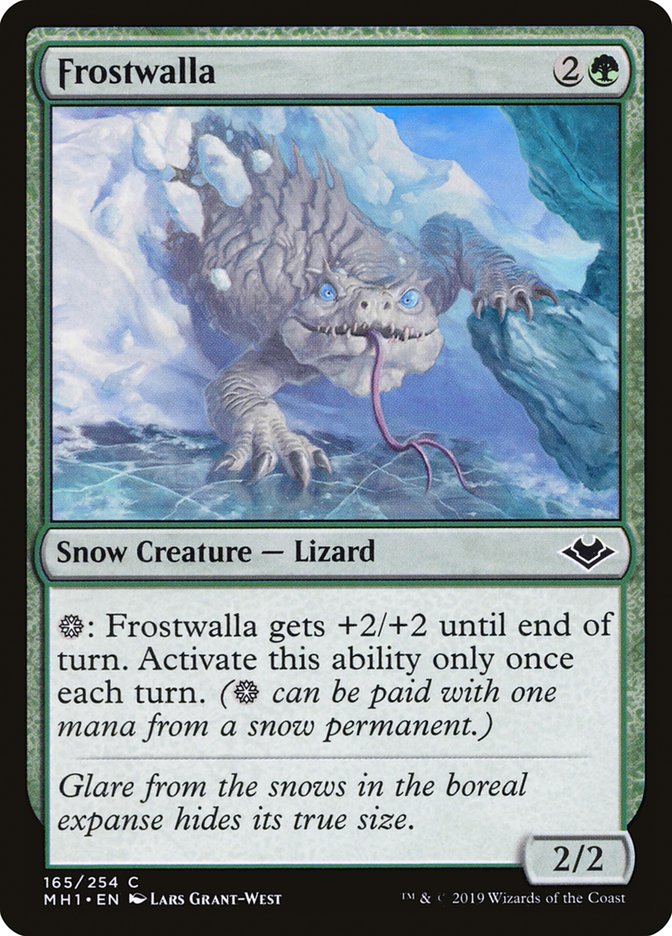
I really get stoked when I get wacky things like Offalsnout, Lathnu Hellion, or Frostwalla — things not tied down to a specific species. I like it when I don’t have to follow something too precisely, but get to have fun with the design.
I also really like it when I can plug some weird interest into an assignment. For example, Excavation Mole’s head is based on a cool little animal called Barker's sharp-snouted worm lizard. As the name suggests, it looks like a little worm, but it’s a mostly sub-terranian lizard with a bony, fin-like crest on it’s skull. Not visible at all in a live specimen, but that became the feature I fixated on as I worked through that piece.
I couldn’t answer this question without bringing up dragons, which I’ve done painfully few of for Magic. Fantasy cliche though they’ve become dragons — worldwide — are culturally ubiquitous embodiments of all kinds of things -- good and bad. They allow us to distill elemental forces or overpowering emotion into physical form. For me, they do all that, but also have that connection to my childhood love of dinosaurs.
MU: Do you have a favorite art medium? If so, does it make fantasy artwork harder or easier to create?
LGW: Outside of MTG, painting in oils is still where I tend to end up, but I’m not restricted to them. It’s not easier, but it’s more interesting as a medium to me.
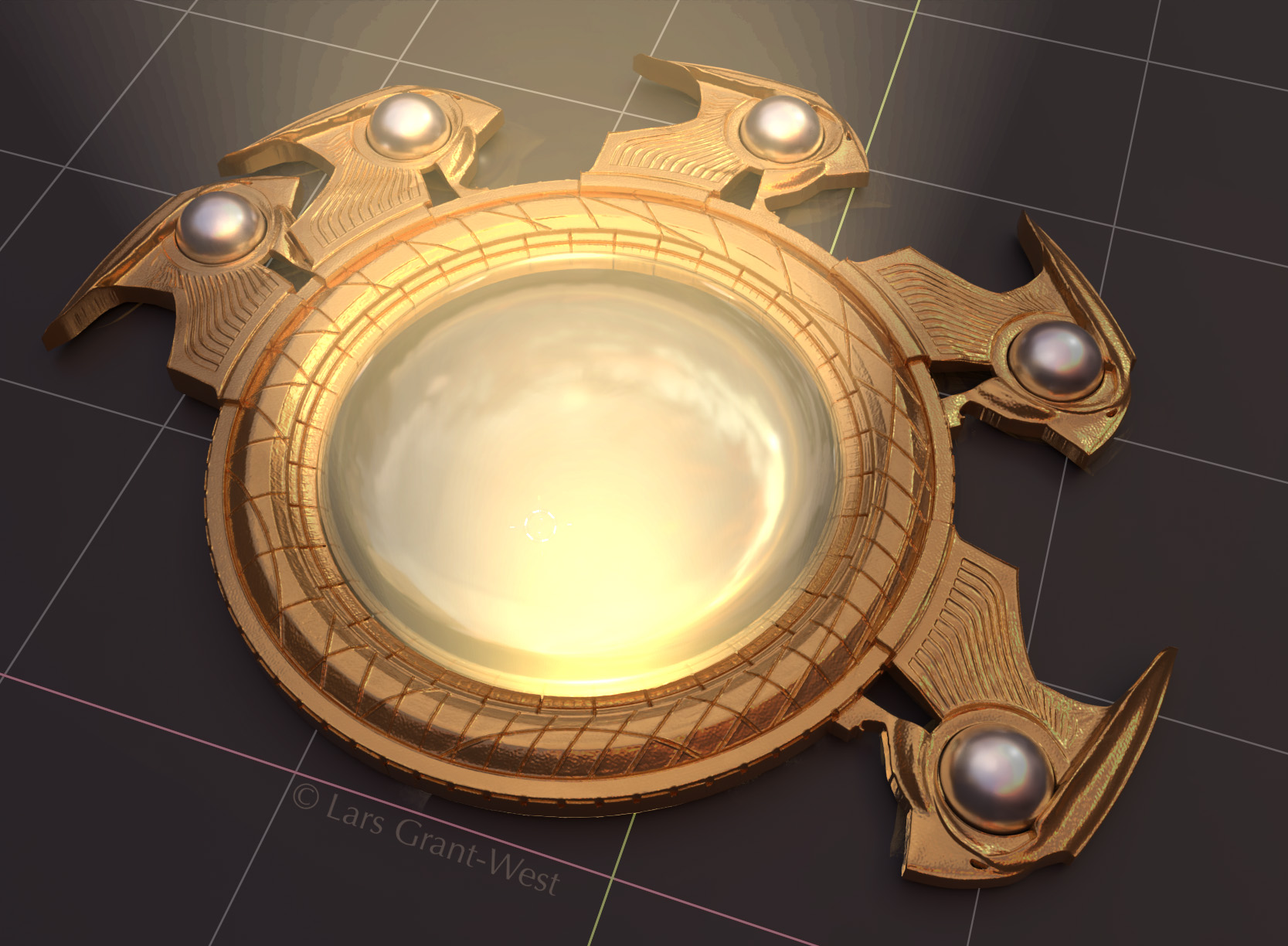
This is a render of the original depth map used to create the Extraplanar Lens render in KPT Bryce. This was what I was experimenting with in 2003. Much cruder than it would be done now. It’s interesting to me how much the vision of Magic has been refined since then.
If anything makes the work harder, it’s that I’m easily sidetracked by strange things. I’ve got work to do, but there are bones degreasing on the windowsill that need to be checked, a trail camera in the back that needs checking, or I need to see if those turtle eggs in the front yard hatched yet…
I don’t know. There’s always something.
MU: Being from Rhode Island, do you ever put a bit of Rhode Island in any of your works? Is there a bit of, say, Roger Williams Park in Magic or D&D?
LGW: It’s all grist for the mill. Like a lot of artists, I’ve got thousands of reference photos. Fortunately, my wife is very patient with me as I run around the woods taking pictures of tree roots or scanning rocks. The zoo was certainly an inspiration. Being near the ocean is as well. Much like the dinosaur skeletons, the awe for nature can be almost incapacitating.
Regular exposure to nature, whether it’s watching waves on the shore or trying to get a photo of an orb weaver in a flower in the back yard, stoke reverence and provide endless inspiration. I like places where nature has started to claw back ground lost to human encroachment. I’m still not sure if my primary love is art, or if art is just the way I express my awe of the natural world. I guess I don’t need a hard answer to that as long as there’s satisfaction and expression in there somewhere.
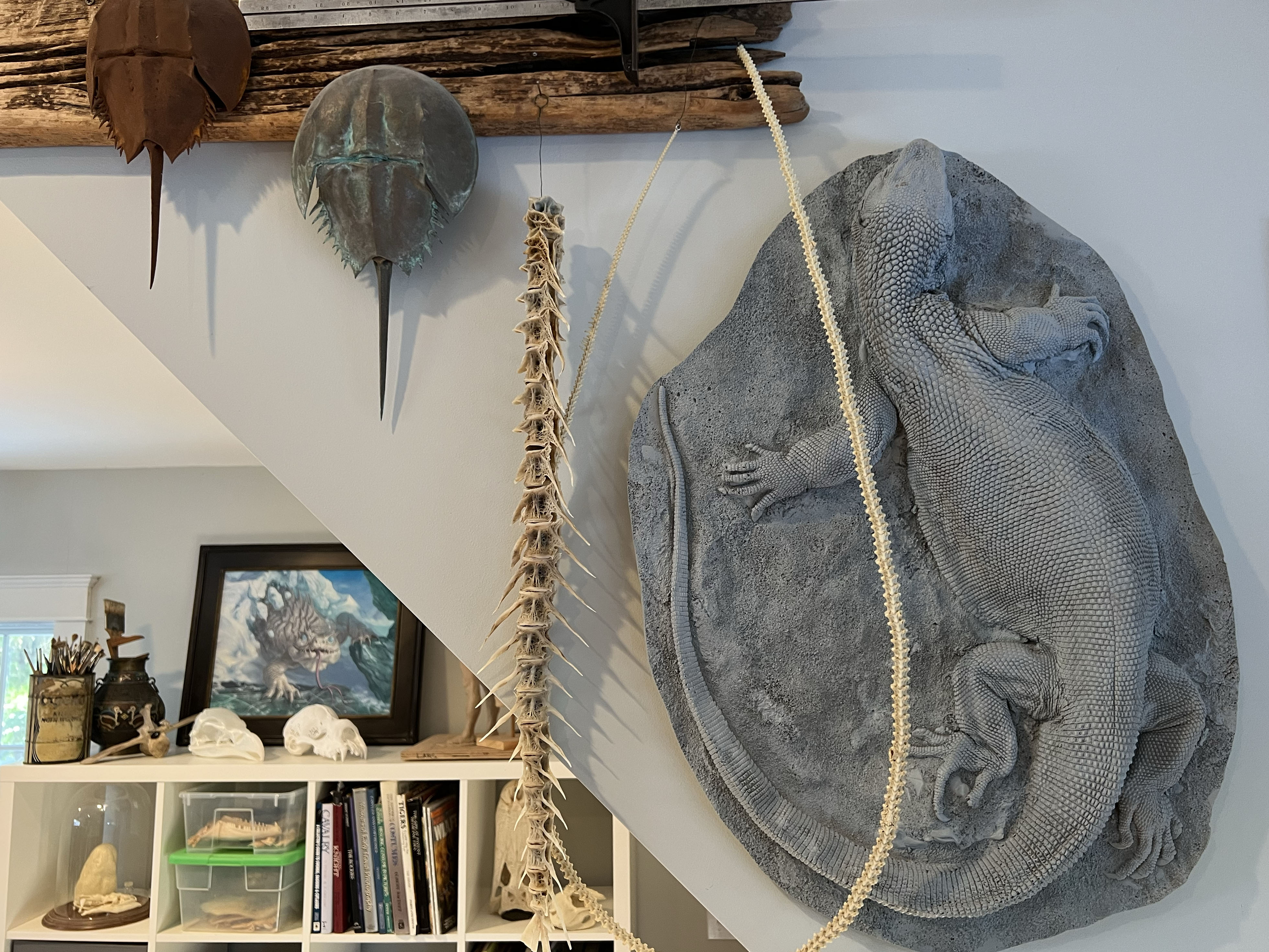
One of the things I also did a lot of at the the zoo was death-casts of reptiles, so those find their way into my reference pool as well.
MU: What kinds of things are more tricky for you to create (landscapes, people, creatures, etc.)?
LGW: Generally speaking, I don’t enjoy painting people as much as all those other things. It’s not that I can’t. I’m just more interested in focusing on other things. As I look back over my work, gothy women like Vein Drinker and Glowspore Shaman seem to be an exception to the rule. I really enjoy painting those. Give me something golgari-esque and I’ll be happy all day long — but there are so many people who absolutely love doing characters, and who are so good at it.
If there are people in an assignment, I prefer that there’s some kind of human-critter interaction. Ikoria is a good setting for that. I love the idea of people paired with (preferably larger) non-human creatures. I have to admit I’ve always loved the idea of painting Liliana riding a zombie dragon. That’s the kind of thing that strikes an interesting balance for me.
MU: Finally, how else can fans of your artwork support what you do?
LGW: If you love the game, please keep supporting human artists. I think most people probably know that AI is stressing a lot of us out. In the face of corporate interests. Art was never broken, and never needed to be automated, except in the interest of making more money for business.
The fans have made careers possible for those of us working on this game and in this field. Your continued support and diligence in calling out and rejecting AI use when it comes into this space means we can keep sharing our love of creating with you.
MU: Do you have any future projects coming out soon you are excited about?
LGW: I’ve got a mile-long list of personal projects I’d love to find time to dig into. There's always something in the wings…but nothing I’m ready to talk about yet. Probably the best way to see when those come up is to keep an eye on my Instagram. I’m not great at posting regularly, but as things come up, that’s where they’ll be. And again, thank you for making this career viable for all of us!